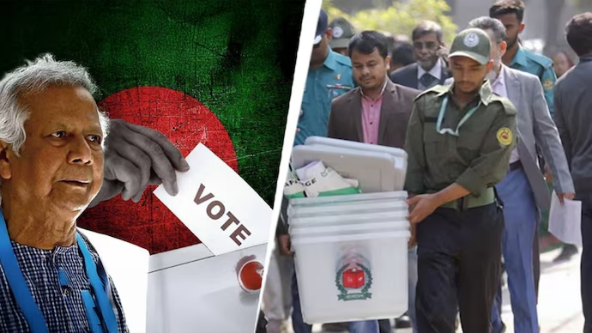
Vote counting begins
Nusmila Lohani · Deputy Editor

Photo taken at centre under Dhaka-16 constituency at 5:17 pm.
Jibon Ahmed
At 4:30 pm, election day officially ended across the country. Now, the counting begins.
12 February 2026
No summaries available yet.
12 February 2026
Curated by Nazmul Ahasan and Nusmila Lohani
Nusmila Lohani · Deputy Editor

Photo taken at centre under Dhaka-16 constituency at 5:17 pm.
Jibon Ahmed
At 4:30 pm, election day officially ended across the country. Now, the counting begins.
Nusmila Lohani · Deputy Editor
The first two polling centre results are in from Bandarban. The BNP candidate Sachin Pru is ahead, bagging 1,379 votes.
Nazmul Ahasan · Executive Editor
Welcome to Netra News’ live blog on Bangladesh’s 2026 elections. The blog is updated and curated by me, Nazmul Ahasan, Executive Editor at Netra News, and my colleague, Nusmila Lohani. First, the basics. Bangladesh is holding what appears to be its first competitive election in more than a decade. The vote has been described as the world’s largest democratic exercise of the year. Around 2,000 candidates are contesting 300 seats, although voting in at least one constituency has been suspended following the death of a candidate. The principal rivals are the Bangladesh Nationalist Party (BNP), widely seen as the frontrunner, and Jamaat-e-Islami, its former Islamist ally, which has gained ground over the past year and a half. The BNP’s chairman, Tarique Rahman, a 63-year-old scion of a prominent political dynasty, is promising stability and economic prosperity for a nation of more than 180 million people. His rival, Jamaat, has largely courted voters on the right, including some former BNP supporters disillusioned by what they see as corruption and violence. The Islamist party has also drawn criticism for its hardline stance on women. It has not nominated a single woman in more than 200 seats it is directly contesting. Its allies include another Islamist figure, Mamunul Huq, and the National Citizen Party, formed by student leaders who helped lead the 2024 uprising that overthrew the authoritarian government of Sheikh Hasina, who fled to India and has remained there since. Sheikh Hasina has been convicted by a local tribunal of crimes against humanity, along with several of her senior lieutenants. Her Awami League party has been barred from participating in the election, and party spokespersons have said this has made the electoral process less than fully participatory. More than 120 million voters, many of them first-time voters, are eligible to cast ballots. An estimated 35% to 45% of first-time voters are under the age of 34, having missed the 2008 election, the last poll widely regarded as free and fair. For Jamaat-e-Islami, winning over these voters has been crucial. Around 245,000 booths are processing voters across approximately 43,000 polling stations nationwide. By midday, the Election Commission told reporters that about one third of voters had already cast their ballots in more than 70% of stations. A turnout of 50% is widely seen as the bare minimum for the election to be considered participatory. Bangladesh has historically recorded high turnouts in competitive elections. The 2008 poll, for example, saw a turnout of 87%. The Secretary of the Election Commission, Akhtar Ahmed, told my colleague Al Amin Tusher at 4.30 pm that official results would be announced at 10 am on 13th February. Informal results, including those we are updating here, are expected to begin emerging by 8-9 pm.